Hedge Funds Are Back, Why Now? The Case for the Asset Class and the Multi-Manager Approach
Two questions sit behind almost every hedge fund allocation. The first is whether hedge funds deserve a place in the portfolio at all. The second, which follows immediately, is how to access them: Directly, or through a diversified portfolio built and managed through a specialist fund of hedge funds. The answers are related but not identical. The case for hedge funds depends largely on the market environment. The case for a fund of hedge funds centres on what it takes to convert that opportunity set into a repeatable return stream.
Part I: Why invest in hedge funds now?
- A favourable market environment for active management: Normalised interest rates, high stock-bond correlations, wider dispersion and elevated volatility have created a more favourable market environment for active management across asset classes.
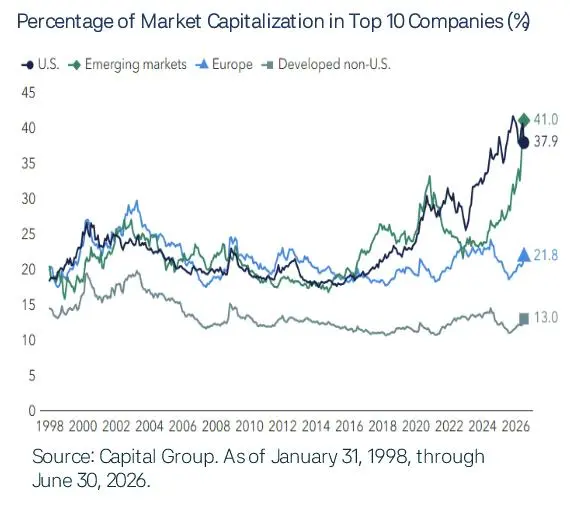
- A fractured market beneath resilient indices: Headline equity indices return remain concentrated in a small number of mega-cap companies, while widening performance differences across companies, sectors and sub-industries create opportunities across a variety of strategies.
- A measurable improvement in hedge fund performance: Hedge funds delivered an average return of 11.2% in 2025, with every strategy contributing positively, while offering lower equity-market correlation and contained drawdowns. Allocator demand and inflows have strengthened accordingly.
- Liquidity has regained its value: Within private markets, liquidity is becoming an increasingly pressing concern. Slower private-market distributions and high levels of committed but uninvested capital are limiting investors' ability to re-invest capital. Against this backdrop, the liquidity offered by hedge funds has become an increasingly important portfolio advantage.
- A distinct role within portfolios: Hedge funds can provide returns above cash and fixed income, diversification across traditional asset classes, and active risk management, including the ability to reduce exposure or profit from market dislocations rather than simply endure them.
Part II: Why invest through a fund of hedge funds?
- Manager Selection and Portfolio Construction: Manager selection is especially critical in hedge funds, where performance dispersion is among the widest across alternative asset classes. Differences in manager skill, risk management and portfolio construction can lead to materially different results, even within the same strategy.
- Access and Capacity: Many hedge funds managers are closed or capacity constrained. Established relationships and a track record as a reliable capital partner can provide access; pooled capital can help meet high minimum investments and secure better terms.
- Genuine Diversification: A fund of hedge funds can assess the combined exposures and diversify deliberately across strategies, regions, styles, time horizons and liquidity profiles. Allocating to several managers does not provide genuine diversification when their underlying positions overlap.
- Risk Management: Industry consolidation, rising fixed costs and increasing operational complexity mean that business stability, governance, talent retention and operational resilience have become key considerations when selecting and monitoring hedge fund managers.
- The Fee Question: The additional fee layer should be assessed on the basis of net returns and weighed against the value of manager selection, access, diversification and risk control, as well as the cost of building the necessary capabilities internally.
- Fund Operation and Simplicity: A fund of hedge funds can simplify administration, risk monitoring and reporting. In addition, investors should choose a reliable partner that provides full portfolio transparency and clearly identifies less liquid positions.
Part I - Hedge Funds are back, why now?
1. A favourable market environment for active management
For most of the last decade, extraordinary monetary policy suppressed volatility, reduced dispersion and rewarded passive investment. Beta was cheap, plentiful and difficult to beat. That period has definitely ended. Interest rates have normalised, volatility is above average, and the gap between the best and worst performing securities has widened to levels rarely seen outside market stress. Correlations between individual stocks have fallen well below their long-term averages: Equities are no longer moving in sync.
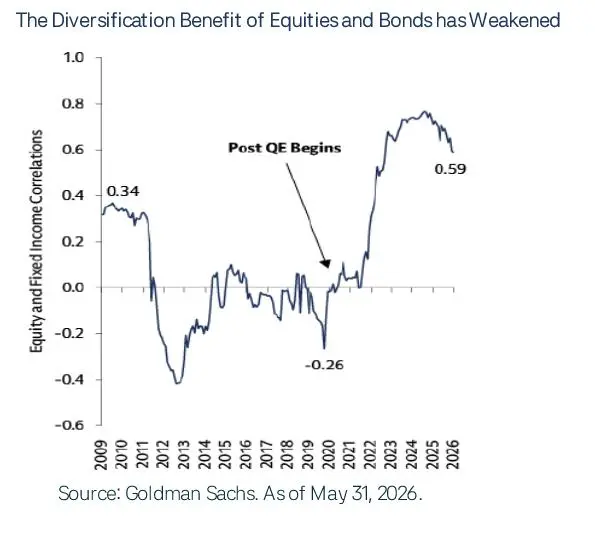
Those three conditions: high stock-bond correlations, high dispersion and elevated volatility provide a favourable trading environment for hedge funds. Through the 2010s they were largely absent, and active management struggled accordingly. They are now present simultaneously, and not only in equities but across all asset classes such as credit, rates, currencies and commodities. Markets have also become far more sensitive to new information, which rewards managers with research depth, technology and the ability to reposition quickly.
2. Beneath calm indices: a fractured market
Headline equity indices continue to grind higher while the share of stocks participating in the rally narrows. Concentration is the signature of the current AI investment cycle: A small group of mega-caps drives index returns, while the rest of the market trades on its own fundamentals. Supply-chain frictions, policy uncertainty and refinancing pressure are already weighing on individual companies even as cap-weighted benchmarks mask the risks. Sector averages hide the same story one level down, where sub-industry performance gaps have widened sharply. Concentration at the top and dispersion beneath it are two faces of the same market.
For benchmark-constrained investors this is uncomfortable. The index is itself an increasingly concentrated bet and being in the wrong name’s costs dearly while the headline number looks reassuring. For a long/short manager it is the opposite. A wide return spread between winners and losers is the raw material of the business, it can be monetised on both sides of the book, without depending on market direction.
3. What this has meant for hedge fund performance
The turnaround is recent and measurable. Through the 2010s the industry stagnated: annualised returns of roughly 4% p.a with alpha of around 50 basis points gave allocators little reason to commit, and the period from 2016 to 2023 saw persistent net outflows averaging USD 30 billion a year. The past two years have reversed that. Assets under management have passed approximately USD 5 trillion following the first consecutive years of double-digit returns since the post-crisis rebound of 2009 and 2010, with 2025 averaging 11.2% and every strategy contributing positively. Returns have been competitive relative to cash, fixed income and broad equity benchmarks while showing markedly lower correlation to equity markets and lower drawdowns, and they have come primarily from alpha rather than market exposure (Barclays Strategic Consulting Team, 2026).
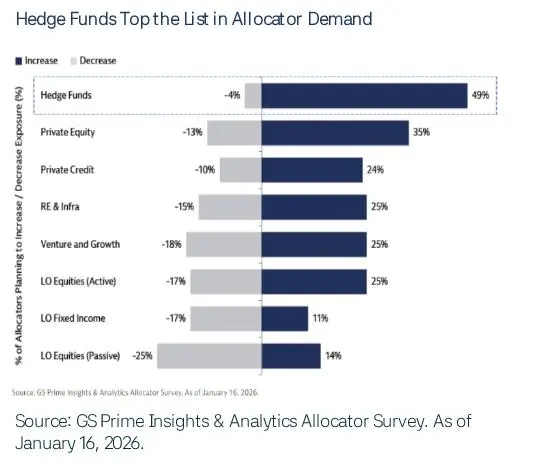
Allocator sentiment reflects this. The overwhelming majority of investors report that their hedge fund portfolios have met or exceeded expectations for a second consecutive year, and the share whose portfolios beat expectations is at its highest level in several years. Hedge funds are once again the most sought-after asset class going into the year, and the margin over competing allocations is the widest on record for several industry surveys. Inflows are at their strongest in almost two decades.
For much of the past decade, investors were willing to lock up capital for extended periods in pursuit of higher returns from private-market investments. This trade-off has become more difficult as distributions have slowed, holding periods have lengthened and substantial amounts of committed capital remain available to be called. Investors may therefore receive less capital back from existing investments while still needing to fund outstanding commitments, limiting their ability to rebalance portfolios or pursue new opportunities.
As a result, liquidity has become increasingly valuable within alternative investments. Hedge funds generally offer more frequent opportunities to redeem capital than private-market strategies, while still providing access to actively managed and differentiated sources of return. This gives investors greater flexibility to meet capital requirements, adjust portfolio exposures and redeploy capital as market conditions change (Barclays Strategic Consulting Team, 2026).
5. The role of hedge funds in a portfolio
At its core, the role of hedge funds in a portfolio is to provide access to differentiated sources of return that are less dependent on the direction of traditional equity and bond markets. By drawing on a broad range of strategies and return drivers, hedge funds can improve diversification, reduce portfolio concentration and contribute to a more resilient portfolio across different market environments. Many strategies also have the flexibility to actively manage risk and adapt exposures as conditions change.
The opportunity set is broad and currently uneven. Equity Long/Short benefits from wide valuation dispersion, elevated single-stock volatility and pronounced differences in performance across companies and sectors. Event-Driven strategies are supported by a strong M&A pipeline, a more predictable regulatory backdrop and governance-led catalysts, particularly in Japan and parts of Europe. Global Macro is favoured by diverging central bank paths, uneven inflation trends and persistent geopolitical uncertainty. Relative Value is improving as market reactivity creates more frequent pricing dislocations, with convertible arbitrage a clear beneficiary of heavy issuance and rising secondary liquidity. Credit Long/Short offers less at the index level, where spreads remain tight, but meaningful issuer-level dispersion beneath the surface.
Part II - Why invest through a fund of hedge funds?
If the case for hedge funds is about the opportunity set, the case for a fund of hedge funds is about implementation. Accessing differentiated sources of return is only the starting point. Outcomes ultimately depend on manager selection, portfolio construction, access and ongoing risk management. As the dispersion between managers has widened, the difference between successful and unsuccessful allocations has become increasingly significant.
At the same time, the hedge fund industry has become more concentrated. Research puts global hedge fund assets at approximately USD 5 trillion at the end of 2025, with around 88% managed by the 579 firms overseeing more than USD 1 billion each. Assets at those firms grew by more than 19% during the year, reflecting both strong performance and continued capital concentration within a smaller group of managers (With Intelligence, 2026).
Concentration of assets, however, is not the same as a verdict on where opportunities are generated. Many attractive strategies remain specialised, capacity-constrained and deliberately operated below institutional scale. Allocators therefore face several challenges at once: identifying skilled managers, gaining access to them, constructing a diversified portfolio and continuously monitoring the associated risks. These challenges form the rationale for the fund of hedge funds approach.
1. Manager selection and portfolio construction drives outcomes
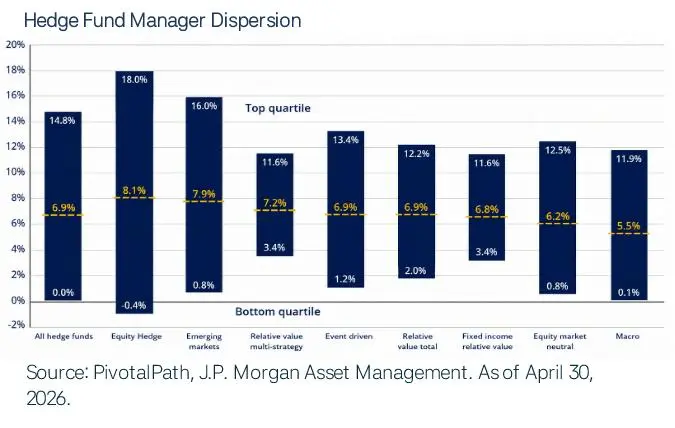
The dispersion between the best and worst performing hedge funds managers within a single hedge fund strategy is far wider than the dispersion within traditional asset classes, and wider still than anything seen in long-only equity. Manager selection is one of the main determinants of the portfolio outcomes, and it depends on sourcing, comparative due diligence, and continuous monitoring conducted by a team with a long institutional memory of how managers behave under stress.
In addition to manager selection, portfolio construction is a key source of value creation. The way managers are combined, sized and monitored can be just as important as the managers themselves. Effective portfolio construction balances different return drivers, manages correlation and concentration risks, and adapts exposures as market conditions evolve.
The most consistent hedge fund managers are frequently closed to new capital and re-open selectively to existing relationships rather than to the market. Access is earned over years, through early participation, scale and reliability as a capital partner. Pooled capital also improves the terms available and makes it possible to reach managers whose minimum allocations would otherwise be prohibitive for a single investor. For many managers, direct access simply is not available at any price to a new allocator.
3. Diversification that is real rather than nominal
Crowding is one of the most underestimated risks in the industry today. The median hedge fund now holds an unusually high proportion of its long exposure in its top ten positions, representing the highest concentration on record and exceeding levels seen during previous market peaks. When positioning becomes this crowded, the unwind tends to be rapid and disorderly, as several sharp factor-driven drawdowns have demonstrated.
An investor holding five managers who turn out to own the same underlying factors and exposures doesn’t construct a diversified portfolio but ultimately is a single bet. A fund of hedge funds underwrites the aggregate portfolio rather than each fund in isolation, combining the underlying exposures to measure genuine overlap, and to diversify deliberately across strategy, region, style, time horizon and liquidity profile.
Professional risk management extends beyond initial due diligence. Effective oversight requires continuous monitoring of organisational stability, personnel changes, asset growth, strategy drift, financing arrangements, counterparty exposures, liquidity terms, governance developments and service provider relationships. Identifying emerging risks early can help limit the impact of market dislocations, operational failures and other sources of tail risk.
The need for continuous oversight is reinforced by the pressures that single hedge funds are facing. These pressures have led to closures outpacing launches for years and the industry continues to consolidate. Technology, data, compliance and risk infrastructure are largely fixed costs, so they absorb a far greater share of a small manager’s revenue than large ones. That makes it harder for smaller firms to build the operational standard institutional allocators expect before committing capital. Larger platforms spread those costs over a bigger asset base and prove more resilient in stressed markets, which in turn attracts capital and talent in a reinforcing cycle. However, scale is no guarantee. As an example, Jain Global launched in 2024 with roughly USD 5 billion, and in April 2026 announced it would return around USD 6 billion to outside investors and trade exclusively for a well-known multi-strategy platform, after start-up and talent costs weighted too heavily of the trading gains.
The practical consequence is that business stability, talent retention and strategy drift now sit alongside performance as core underwriting questions. Operational due diligence is a specialist, ongoing discipline covering valuation policy, financing and counterparty arrangements, governance, service providers key-person exposures and many more. Most allocators cannot resource it properly, and the cost of getting it wrong is asymmetric.
An additional layer of fees is real and should be assessed honestly, on net returns. The relevant question is whether selection, access, diversification and risk control add more than that layer costs. In a universe where the gap between strong and weak managers is unusually wide, where the best capacity is genuinely restricted, and where a single manager failure can erase years of accumulated return, the answer is more often yes than in a market where returns are broadly distributed. The comparison should also account for the cost of the alternative: a credible in-house programme requires research, due diligence, legal, risk and operational resource that few allocators can justify below significant scale.
6. Fund operations and simplicity
Finally, there is the practical dimension. A single allocation in a fund of hedge funds replaces dozens of subscription documents, side letters, capital calls, reporting formats and counterparty relationships. Risk is consolidated and reported in one framework. The investment committee is able to focus on the size and role of the allocation rather than its administration. This makes the choice of partner important: external investors should expect full portfolio transparency, with less liquid positions identified rather than hidden within the structure.
Conclusion
For the first time in more than a decade, the market environment is structurally aligned with what hedge funds are built to do. Normalised rates, elevated dispersion, macro divergences and a renewed premium on liquidity all point towards a supportive setting for hedge fund allocations.
The same conditions that create the opportunity also increase dispersion between managers, and the industry itself is transforming at its fastest pace and consolidating around scale, access and specialisation. Capturing the opportunity requires careful selection, access, genuine diversification and disciplined operational oversight that is sustained continuously, not decided once. That is precisely what a fund of hedge funds is built to provide.
AQUIS Capital AG is a Swiss-licensed specialised multi-asset management boutique, specialising in hedge funds and Emerging Asia opportunities. Providing expertise across a range of strategies and asset classes, the firm manages the Abacorum Fund, a global multi-strategy fund of hedge funds, and provides hedge fund advisory mandates to institutional investors. AQUIS seeks to offer access to compelling hedge fund opportunities, diversified sources of return, and effective risk management solutions. As a 100% independent firm, AQUIS Capital prioritises client-focused solutions through a dedicated team of investment professionals with extensive experience across Fund of Hedge Funds and Emerging Asia.