Hedge Funds Explained: What They Are, How They Work and Key Strategies
Ask ten investors what a hedge fund actually is and most will describe something vaguely risky, vaguely secretive, and vaguely for the rich. That reputation is not wrong, but it is not a definition either.
A hedge fund is a pooled investment fund that uses a broader toolkit than a conventional fund — short selling, leverage, and derivatives among them — to pursue returns that do not simply track the market. Below, hedge funds explained in plain terms: what one is, how it actually works, the main strategies behind the label, and how the structure compares with a mutual fund.
What is a hedge fund?
The hedge fund definition, in plain terms: a pooled investment vehicle that holds relatively liquid assets and uses active trading and risk-management techniques — including short selling, leverage and derivatives — to try to generate returns and cushion them against broad market swings. That is the hedge fund meaning behind the name, and it already explains why the term is broader than most people expect.
Unlike a private equity fund, a hedge fund is usually open-ended: investors can subscribe and redeem periodically based on net asset value, rather than waiting years for a fixed exit. Unlike a mutual fund or ETF, it is not built for the retail shelf — in the United States, regulation restricts marketing to institutional investors and high-net-worth individuals, typically "accredited investors" with more than USD 200,000 in annual income or USD 1 million in net worth outside their primary residence.
The name itself is a hedge fund example of finance borrowing a word and redefining it. In March 1949, Alfred Winslow Jones set up what he called a "hedged fund" — roughly half the portfolio in long positions expected to rise, the other half short, betting against positions expected to fall. That combination was meant to hedge against the market's direction. Jones is also credited with the 2-and-20 fee structure that still defines the industry: a 2% annual management fee on assets, plus 20% of any gains.
How do hedge funds work?
A hedge fund is typically structured as a limited partnership, limited liability company or offshore corporation, run by an investment manager that is legally separate from the fund itself. The manager sets strategy and makes allocation decisions; prime brokers, fund administrators and auditors handle execution, financing, valuation and reporting around it.
Leverage — borrowing capital or using derivatives to gain more market exposure than investors' capital alone would allow — is one of the tools that separates a hedge fund from a mutual fund. It is often assumed to be extreme, but research from the National Bureau of Economic Research puts average hedge fund leverage at roughly 1.5 to 2.5 times capital, well below the 14.2 times reported for investment banks. Leverage amplifies both gains and losses, which is why funds using it typically run more extensive risk management around position sizing, liquidity and scenario analysis.
Fees follow the same 2-and-20 logic Jones introduced: a management fee (commonly 2% of net asset value, though the industry range is 1–4%) covers operating costs, and a performance fee (commonly 20% of gains, with a range of 10–50%) rewards results. Most performance fees include a high-water mark, meaning the fee only applies once any prior losses have been recovered — a manager does not get paid twice for the same gains.
What are the main hedge fund strategies?
There is no single hedge fund strategy — the label covers a range of approaches, and most funds combine more than one for diversification. The broad families are:
Strategy | What it does | Typical driver of return |
|---|---|---|
Long/Short Equity | Holds long positions in favoured stocks, short positions in others | Stock selection, not market direction |
Global Macro | Takes positions across currencies, rates, equities and commodities based on macroeconomic views | Macroeconomic analysis |
Event-Driven | Positions around mergers, restructurings or other corporate events | Outcome of a specific event |
Relative Value / Arbitrage | Exploits pricing gaps between related instruments | Convergence of mispriced assets |
Managed Futures / Systematic | Rules-based, model-driven trading across asset classes | Trend and momentum signals |
A closer look at how these approaches are combined and risk-managed in practice is covered in our dedicated article on hedge fund strategies and portfolio construction. A fund that blends several of these strategies in one vehicle rather than running a single approach is usually described as a multi-strategy fund of hedge funds.
The strategy label describes where the return is expected to come from. It does not describe the risk of losing money — that has to be assessed separately, fund by fund.
Types of hedge funds: single-manager, multi-manager and fund of hedge funds
Beyond strategy, hedge funds are also grouped by structure. A single-manager fund runs one investment team and one process. A multi-manager (or multi-strategy) hedge fund houses several teams or strategies inside one vehicle. A fund of hedge funds goes a step further: instead of running strategies in-house, it invests in a portfolio of external hedge fund managers, so an investor gets diversified exposure to several managers and strategies through a single position.
Listed hedge funds also exist, traded on exchanges such as the Irish Stock Exchange, and these can in principle be bought by non-accredited investors — a narrow exception to the usual restriction.
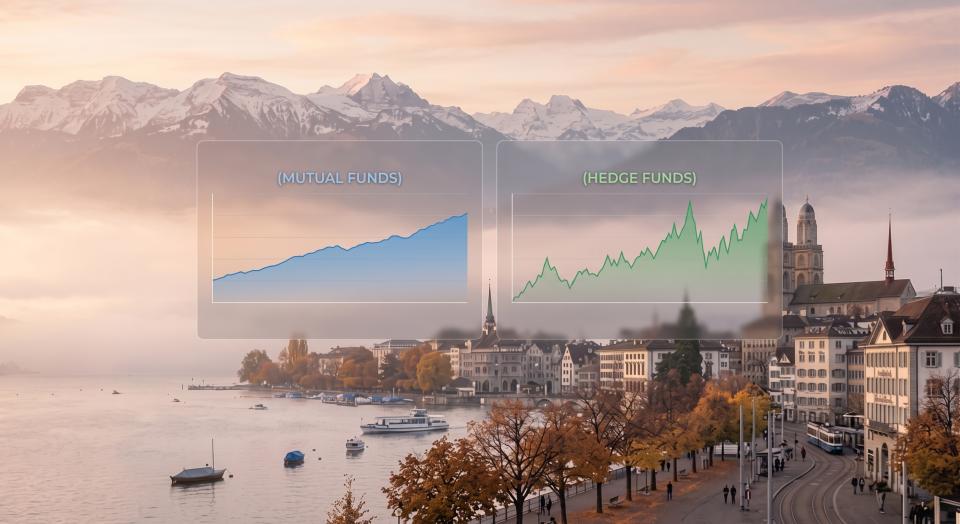
Hedge fund vs mutual fund: what is the difference?
The two are often confused because both pool investor money into a managed portfolio. The differences that matter are regulatory and structural, not just about return targets.
Hedge fund | Mutual fund | |
|---|---|---|
Who can invest | Institutional and accredited/high-net-worth investors | Retail investors, no eligibility test |
Regulation | Lighter — exempt from most public-fund registration requirements | Extensive — e.g. the Investment Company Act of 1940 in the US |
Leverage and short selling | Permitted, actively used | Restricted or prohibited |
Liquidity | Often monthly or quarterly, sometimes with a lock-up period | Daily |
Fees | Management fee plus performance fee (2-and-20 model) | Management fee only, no performance fee |
Because performance fees reward gains without symmetrically penalising losses, they have drawn criticism — Warren Buffett among the critics — for potentially encouraging higher risk-taking. High-water marks exist specifically to limit that incentive.
Are hedge funds regulated?
Yes, though less prescriptively than mutual funds. In the United States, hedge fund managers with more than USD 100 million under management generally register with the SEC under the Investment Advisers Act and file periodic disclosures; the Dodd-Frank Act extended reporting requirements after 2010. In the United Kingdom, where roughly 80% of Europe's hedge fund industry is based, managers are authorised and supervised by the Financial Conduct Authority.
Within the EU, hedge fund managers fall under the Alternative Investment Fund Managers Directive. In Switzerland, alternative fund managers operate under FINMA supervision. The practical point for an investor: regulation governs the manager and the offering process, not a guarantee on the strategy's returns.
For investors evaluating exposure to hedge fund strategies as part of a broader allocation — including through vehicles such as a family office — the practical question is less "is it regulated" and more "does the manager's process, risk framework and liquidity terms match the mandate."
Frequently asked questions
What is a hedge fund in simple terms?
A pooled fund that uses a wider set of tools than a typical fund — short selling, leverage and derivatives — to try to generate returns that do not simply move with the overall market, and that is offered only to institutional and high-net-worth investors rather than the general public.
What is an example of a hedge fund strategy?
Long/short equity is a common example: the fund buys stocks it expects to rise and short-sells stocks it expects to fall, so the result depends more on stock selection than on the market's overall direction.
Why is it called a "hedge" fund if it can be risky?
The name comes from the original 1949 structure, which combined long and short positions to hedge against market direction. Modern hedge funds keep the name even though many strategies — particularly those using significant leverage — carry meaningful risk, including the possibility of losing the entire investment.
How is a hedge fund different from a mutual fund?
Eligibility, regulation and tools. Hedge funds are restricted to accredited or institutional investors, face lighter public-disclosure requirements, and can use leverage and short selling that mutual funds generally cannot.
How are hedge fund managers paid?
Typically under a "2-and-20" model: a management fee of around 2% of assets per year, plus a performance fee of around 20% of gains, usually subject to a high-water mark so fees are not charged twice on the same recovered losses.
Are hedge funds only for the ultra-wealthy?
Direct investment generally requires accredited-investor or institutional status. Institutions such as pension funds, endowments and family offices access hedge fund strategies on behalf of underlying beneficiaries or family members who would not qualify individually.
A hedge fund is not one thing — it is a regulatory category that happens to contain very different strategies, risk levels and structures underneath it. The label tells you how the vehicle is regulated and who can invest; it does not tell you whether the strategy inside it is a good fit. That still has to be assessed case by case.
This article is for general information only and does not constitute financial, investment, tax or legal advice, nor an offer or solicitation to invest in any fund. Hedge fund strategies carry risk, including the possible loss of capital, and are not suitable for all investors. Figures cited are drawn from published academic and regulatory sources and will vary by fund and jurisdiction. Consult a licensed professional before making investment decisions.